COMPLETE BOOK OF VOLKSWAGEN GTI

It’s the 50th anniversary of the GTI, and Russell Hayes writes the definitive book for the occasion—every Volkswagen GTI model since it launched in model year 1976 is showcased.
By Roy Nakano
Mon, Feb 16, 2026 02:00 PM PST
Featured image above: The cover image of "The Complete Book of Volkswagen GTI: Every Model Since 1976" by Russell Hayes (Motorbooks)
At the end of 2025, LA Car published its top book picks and singled out Russell Hayes’ The Complete Book of Volkswagen GTI.
With 2026 being the 25th anniversary of the GTI’s launch, it’s time for a deep dive into Russell Hayes’ book.
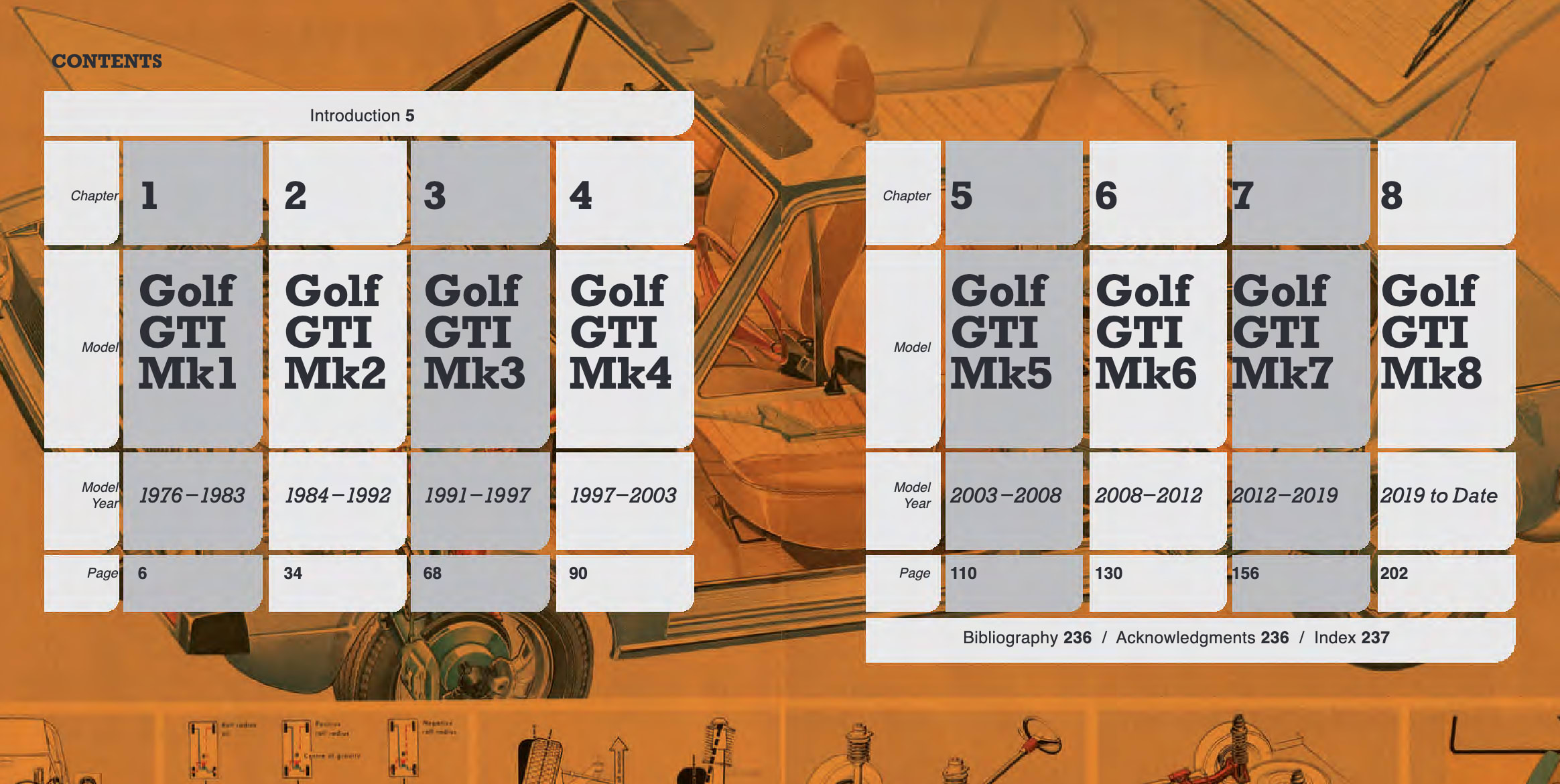
Working in conjunction with Motorbooks and The Quarto Group, Hayes provides us with a coffee table-worthy book covering all eight generations of the iconic German hot hatchback.
But Hayes doesn’t stop there.
The author calls this The COMPLETE Book of Volkswagen GTI, so there are details on related performance models like the Scirocco, Corrado, Jetta GLI, and the Golf R.
In addition, insights on VW engineering through interviews with key GTI figures are part of this collection.
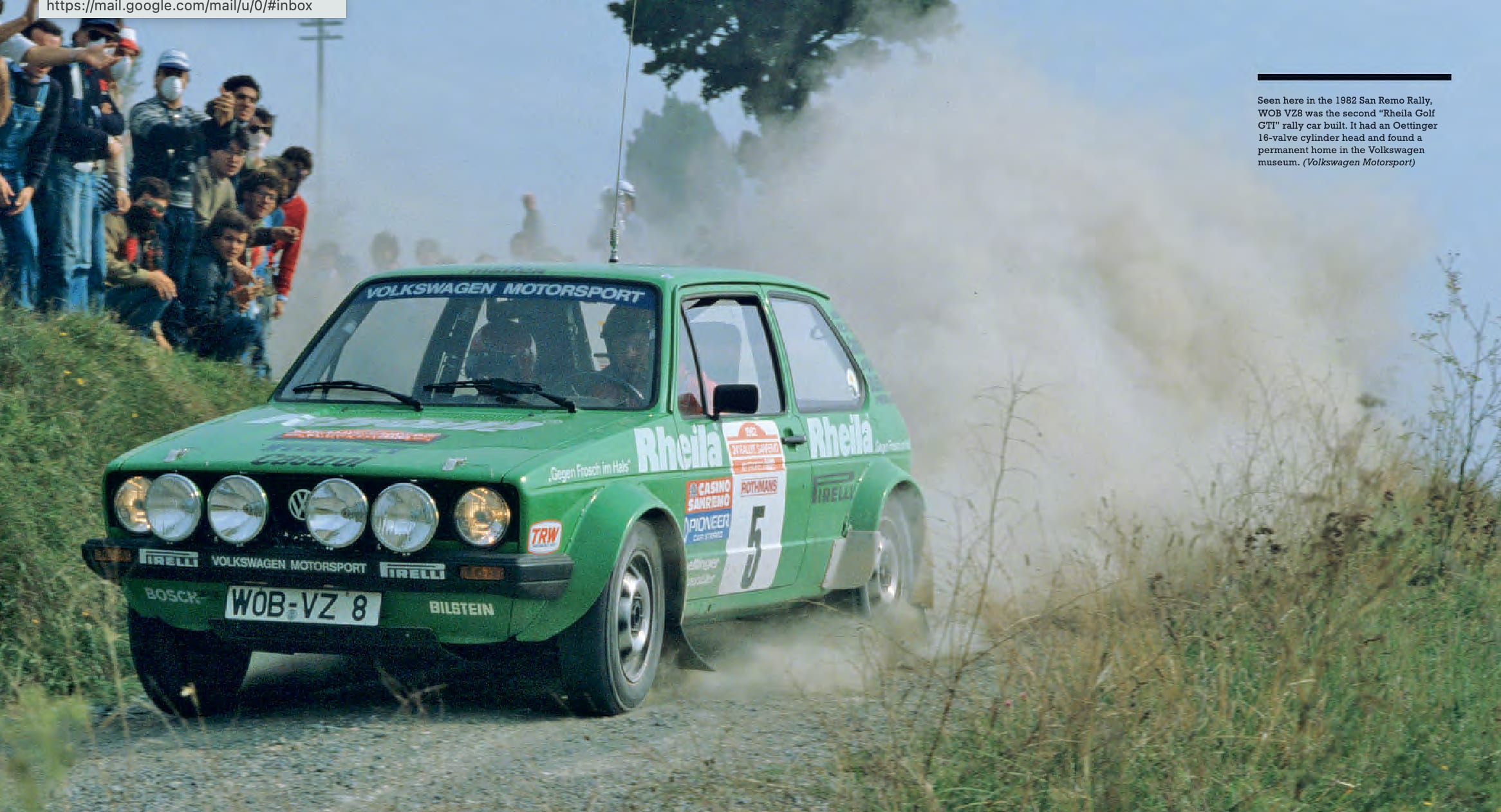
And, last but not least, Hayes provides a look back at the GTI’s racing history, including World Rally, Touring Car histories.
What we have here is everything, including the GTI kitchen sink.
“Don’t judge a book by its cover.” – George Eliot (AKA Mary Ann Evans)
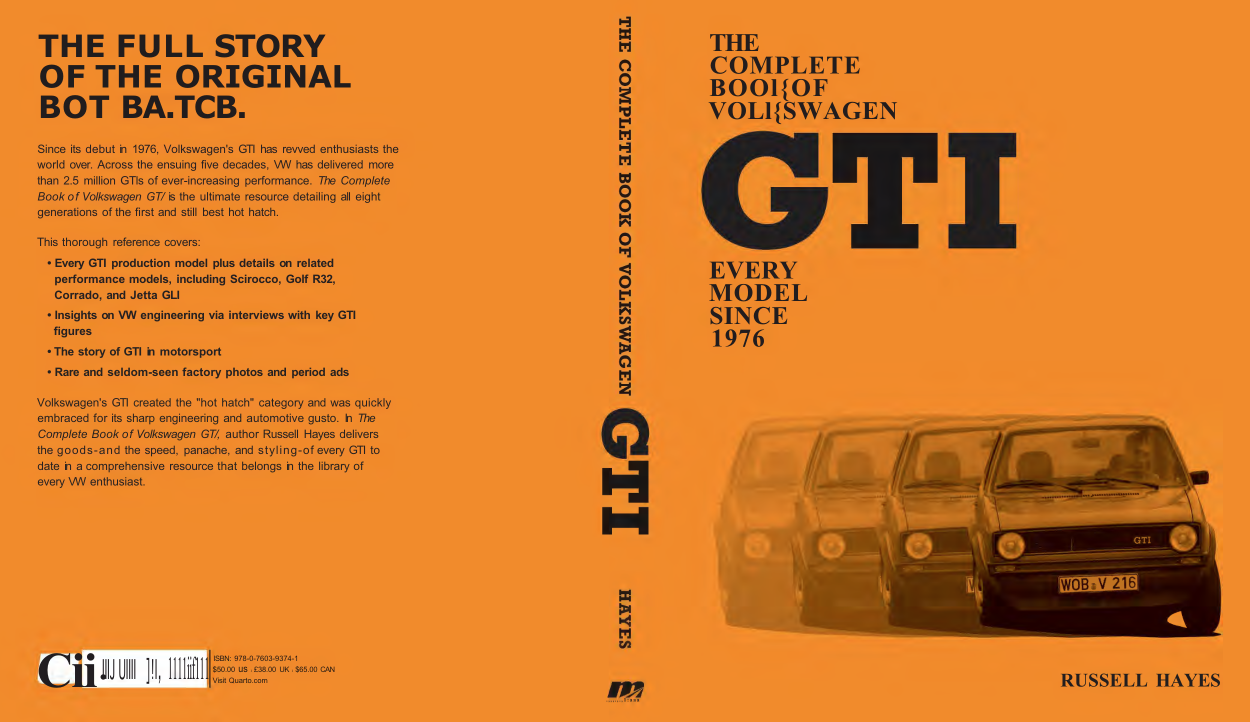
That seems to apply to The Complete Book of Volkswagen GTI, as its plain orange cover won’t win any beauty contests.
The publisher chose to forgo eye-catching photography for the cover. Rather, it’s the title of the book that stands out—and presumably that’s what matters when the book is on display.
It’s a different story when you look beyond the cover.
Open the 240-page book, and that’s where you’ll find the beauty. Virtually no page is left undone. Even the inside covers are printed with the signature GTI tartan plaid fabric inserts.
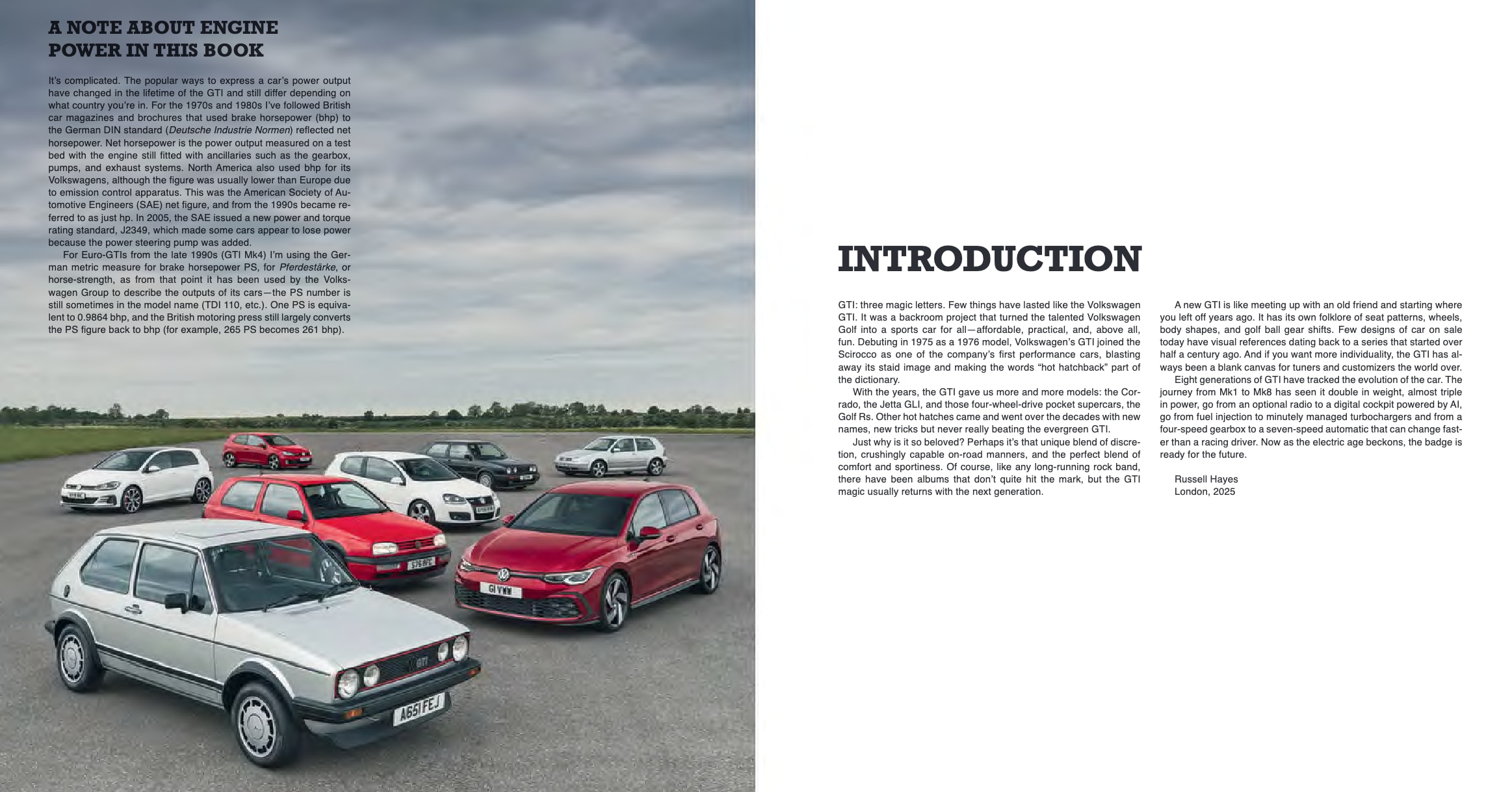
The sequence is fitting, starting with GTI conception and infancy. As Hayes leads off in the Introduction:
“Few things have lasted like the Volkswagen GTI. It was a backroom project that turned the talented Volkswagen Golf into a sports car for all—affordable, practical, and, above all, fun.”
So, Hayes goes on to describe how a group of a half dozen employees at Volkswagen secretly devised a plan for a sportier version of the Golf back in the early 1970s.
A year later, Board Member for Technology Hermann Hablitzel presented the project to the Chairman of the Board of Management, who gave it the green light.
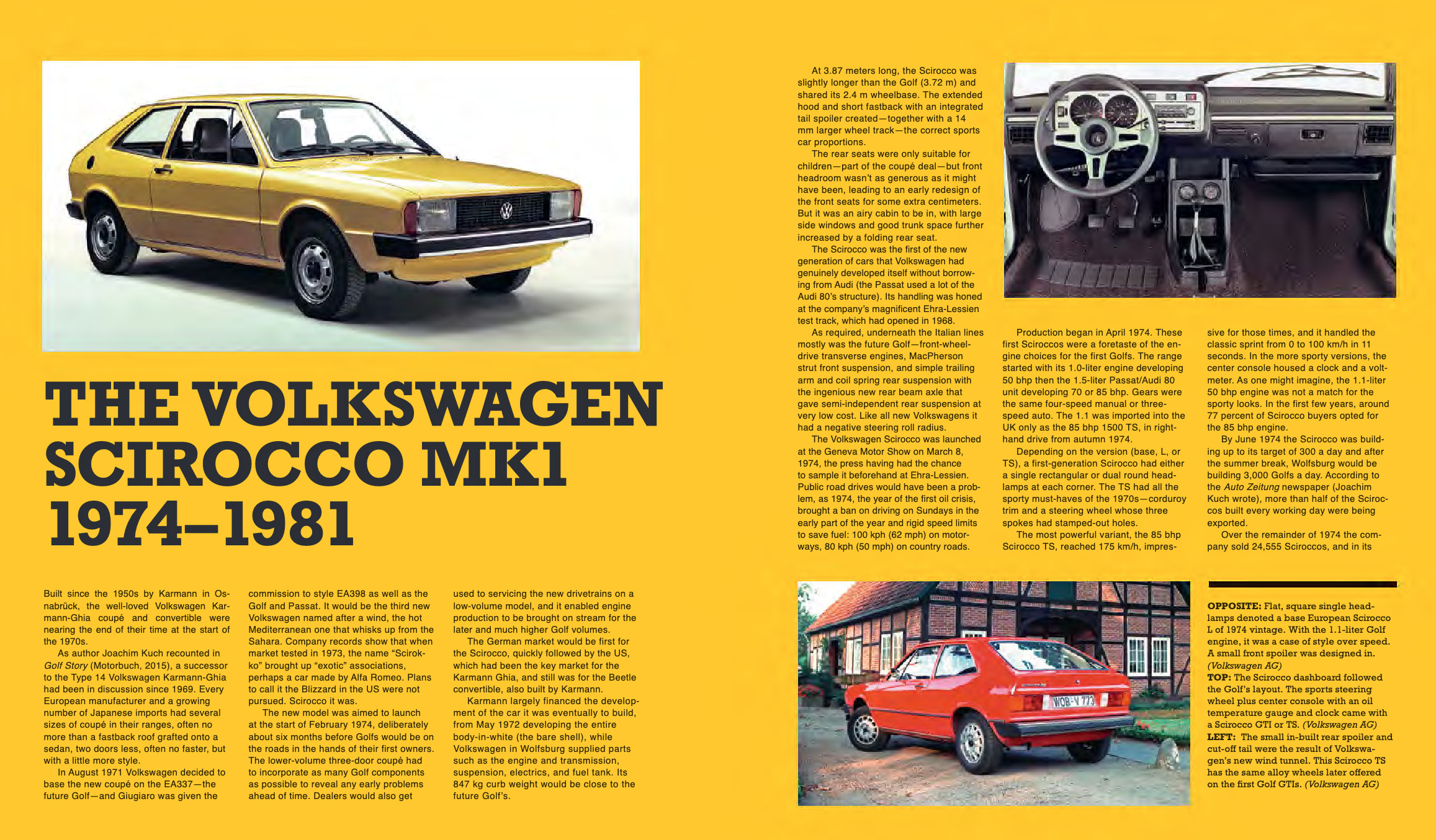
First, the Scirocco
One may think the book should then segue to the Mk 1 Golf GTI, but Hayes sticks to his chronological script: The Scirocco came before the launch of the Golf GTI, so the Mk 1 Scirocco makes the stage appearance before the Mk 1 Golf GTI.
The book then turns to the Golf GTI’s growing years and maturity.
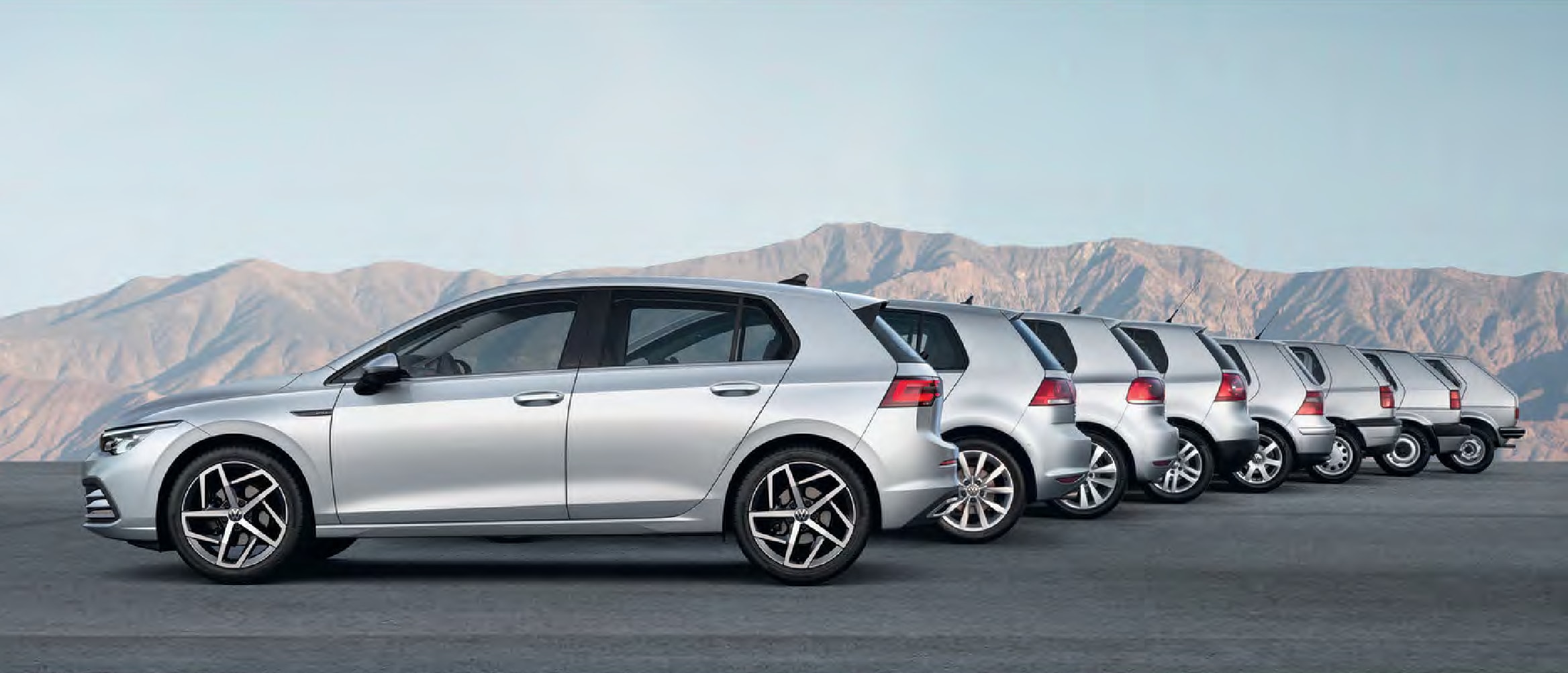
Eight Generations
All eight generations of the GTI are presented in chronological order, including the major upgrades between generations such as the Mk5 Edition 30, Mk 7.5 and Mk 8.5 models.
Hayes devotes an entire section on tuning the Mk1 GTI, with manufacturer and aftermarket efforts showcased. Still another section is devoted to the first GTIs in motorsports.
American Rabbits
The author presents an unvarnished picture of the US-built Golf, also known as the Rabbit:
“Buyers had found the American Golf to be badly built and the Rabbit was judged a little too American by the magazines and enthusiast buyer, with its soft seats and soft suspension.”
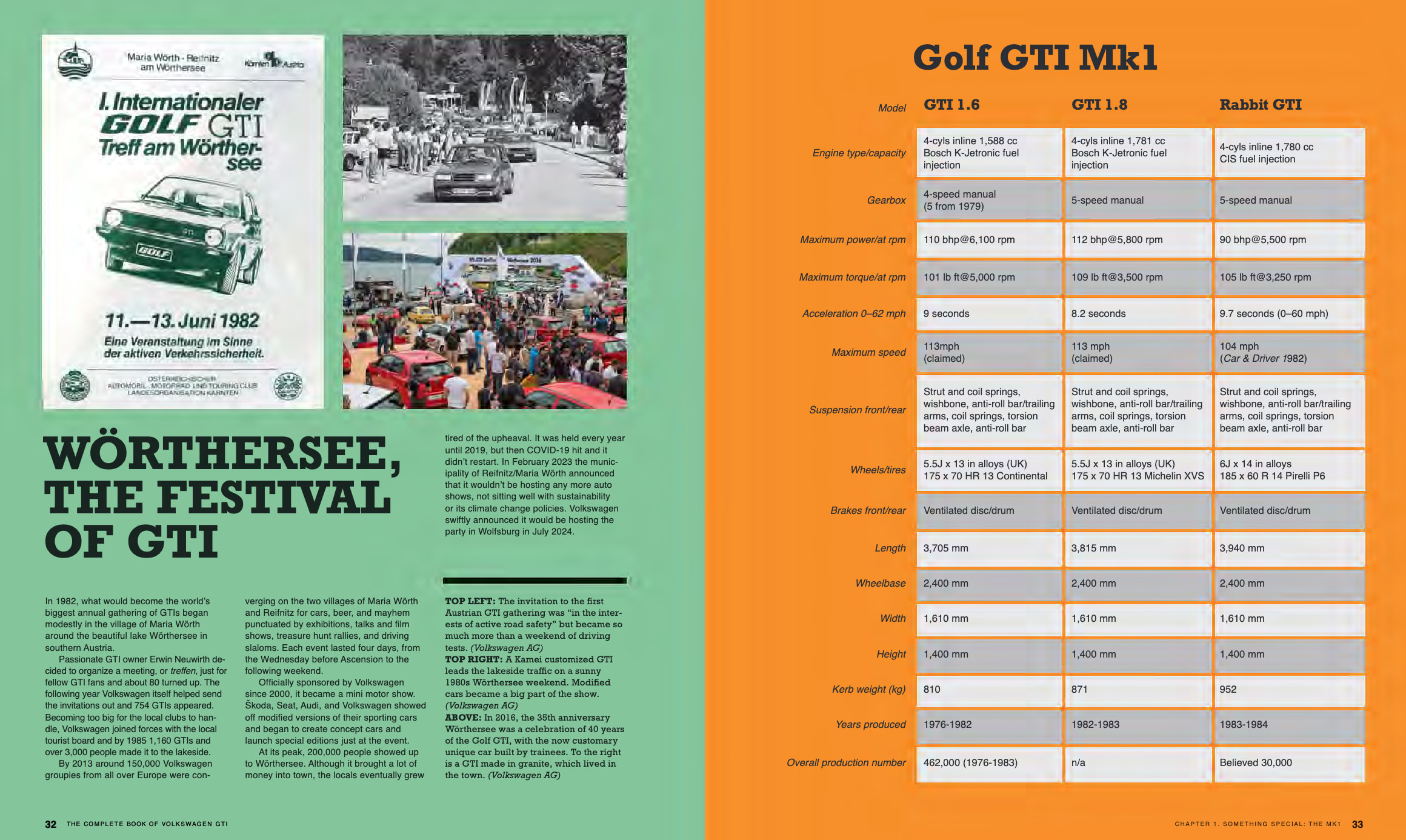
Ultimately, Volkswagen of America launched its version of the GTI for the 1983 model year. The Rabbit GTI produced 90 bhp and did 0-60mph in 9.7 seconds.
That seems pretty slow by today’s standard, but as the author points out, “this was a second quicker than the five-liter four-speed Pontiac Trans-Am.”
Take Two
Not surprisingly, the author doesn’t confine this section to the GTI.
The second-generation Scirocco preceded the second-generation GTI by three years.
And after only one year on the market, a second-generation Jetta GLI was launched (there’s not much on the first-generation GLI, but it was only on the market for model year 1984).
It was also the generation that introduced the 16-valve version of the Volkswagen’s in-line four-cylinder engines, resulting in a significant increase for the GTI and other vehicles it was fitted in.
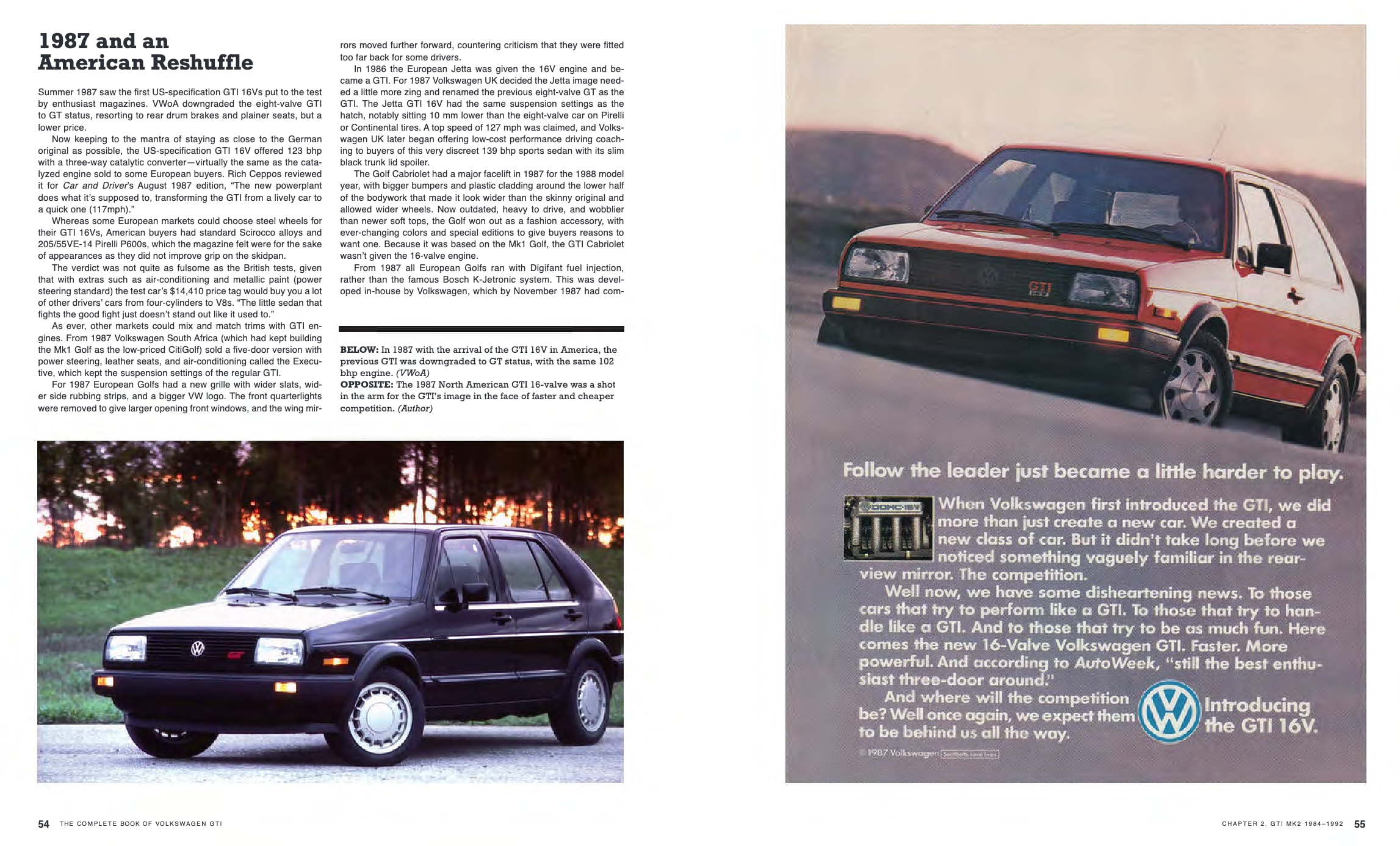
Holding up the rear of the generation two section is a discussion on the stylish Corrado, which replaced the second-generation Scirocco.
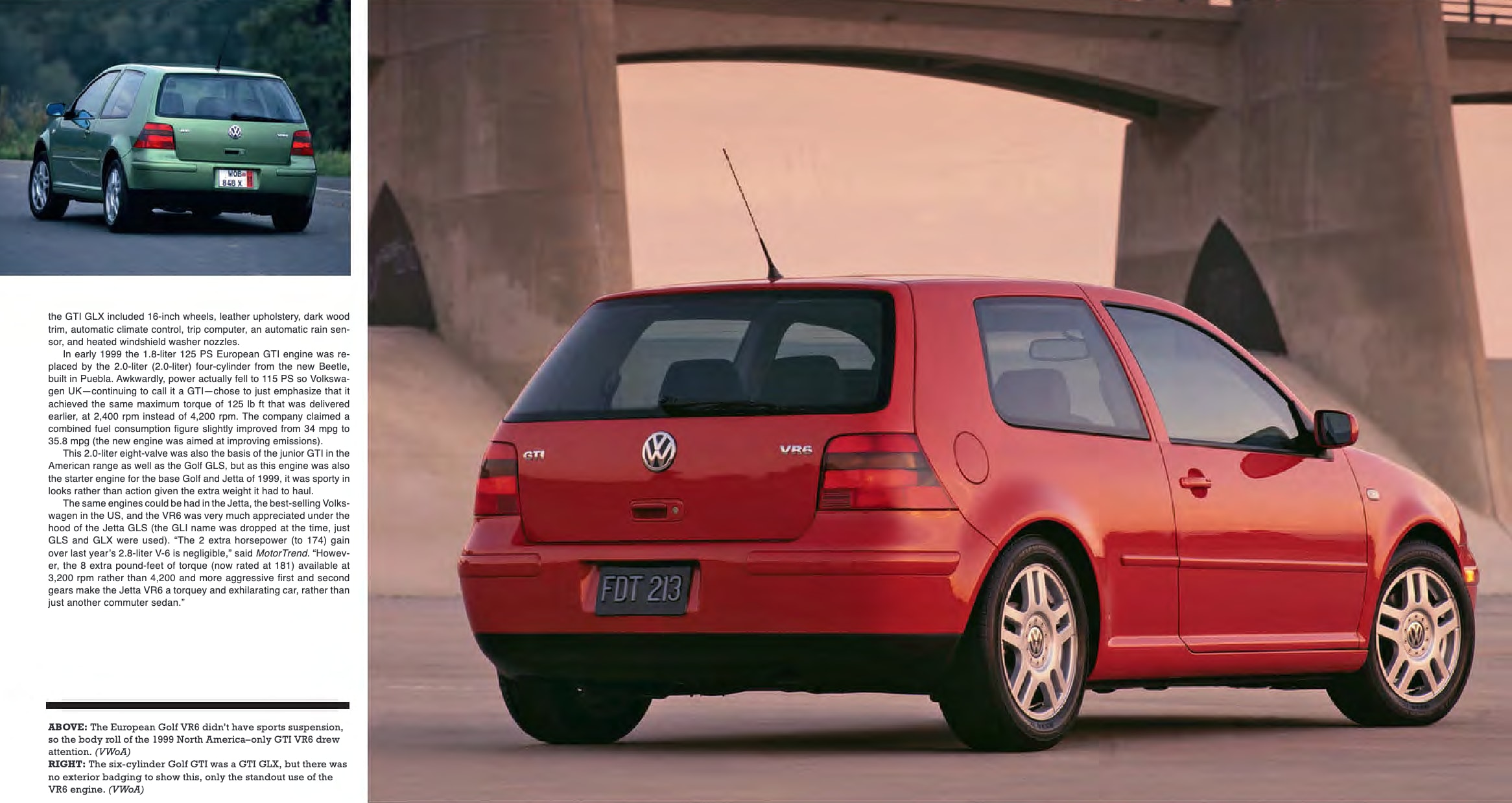
Later versions of the Corrado would be fitted with VW’s then new VR6 engine, which simultaneously earned a reputation among enthusiasts for its power delivery and mechanical strength, and a reputation among general consumers for high maintenance requirements.
Generation Three
Many GTI aficionados point to the Mk3 generation as producing some of the most “un-GTI”-like GTIs. The author is quite candid about this.
The Mk3 was heavier, making the base 8-valve in-line four particularly sluggish.
A couple years later, VW introduced the GTI with the mighty VR6 engine. However, the VR6 models typically weighed about 250 pounds more than the base four.
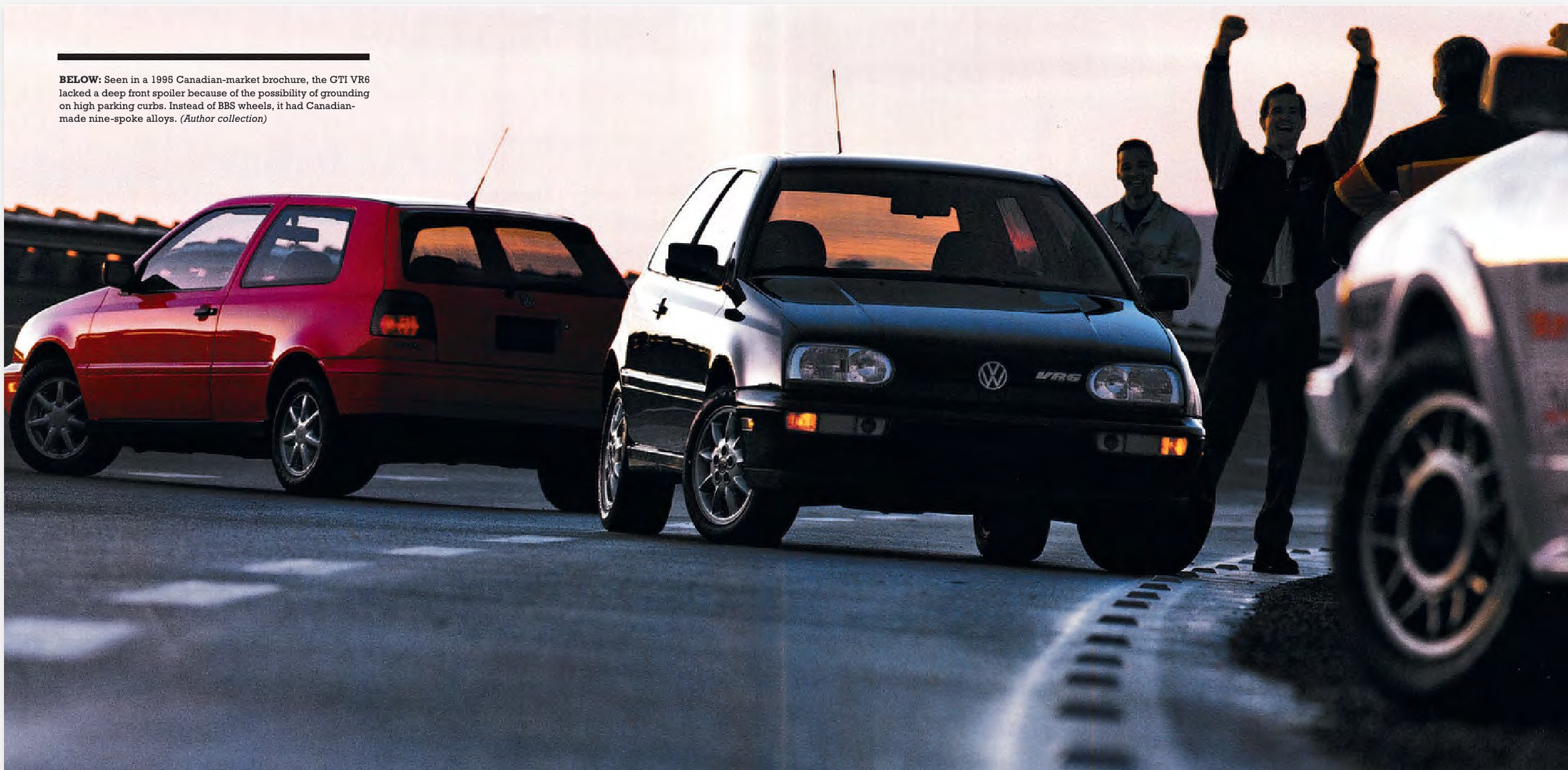
The extra weight sat mostly over the front wheels, making the VR6 GTI less nimble around corners and more prone to understeer.
Gen 4: The Best-Looking Golf?
As author Russell Hayes puts it:
“To many Golf fans the fourth generation remains a classic design that has aged rather well and as it turned out was built remarkably well—many were still on the road over 25 years later.”
Chief designer Hartmut Warkuß paid particular attention to how the cut lines complemented the shape of the Mk4 GTI. The result was an unusually clean-looking design.
The Mk4 Golf, along with its sibling, the B5 Passat, had a huge impact on interior design for the coming generations of Volkswagen competitors. Says, Hayes:
“A technique called ‘slush molding’ gave a soft, grained feel to the top section of the dashboard while the lower sections that you didn’t usually touch were made from a harder-surfaced plastic. It really did give the new Golf a ‘mini-Mercedes’ ambience.”
This technique was carried over to the doors. A few years later, competitors copied the technique.
Today, it’s standard practice in the industry to use more premium, soft-touch material in the places highly visible in the interior, while hard plastics are used in low-visibility and low-contact areas.
A Tuner’s Delight
In model year 2000, the outstanding 1.8T turbocharged 20-valve inline four, originally seen in the Audi A4, became the standard GTI powerplant.
The 1.8T also became a popular tuner engine, as aftermarket companies manufactured replacement microchips that significantly boosted horsepower for relatively very little money.
This generation is also noteworthy for launching the very first Golf R. It was called the R32, and it marked the first time that a Golf can be had with the revolutionary dual-clutch automatic Direct Shift Gearbox (DSG) and launch control.
Game Changing
By the time the Mk4 GTI reached its twilight years, its competition had caught up, and in some cases surpassed the hot hatch from Volkswagen.
According to author Hayes, VW had lost the engineering advantage to the Ford Focus RS, and cars like Honda’s Civic Type R and Renault Megan Renaultsport were beloved by the European car magazines.
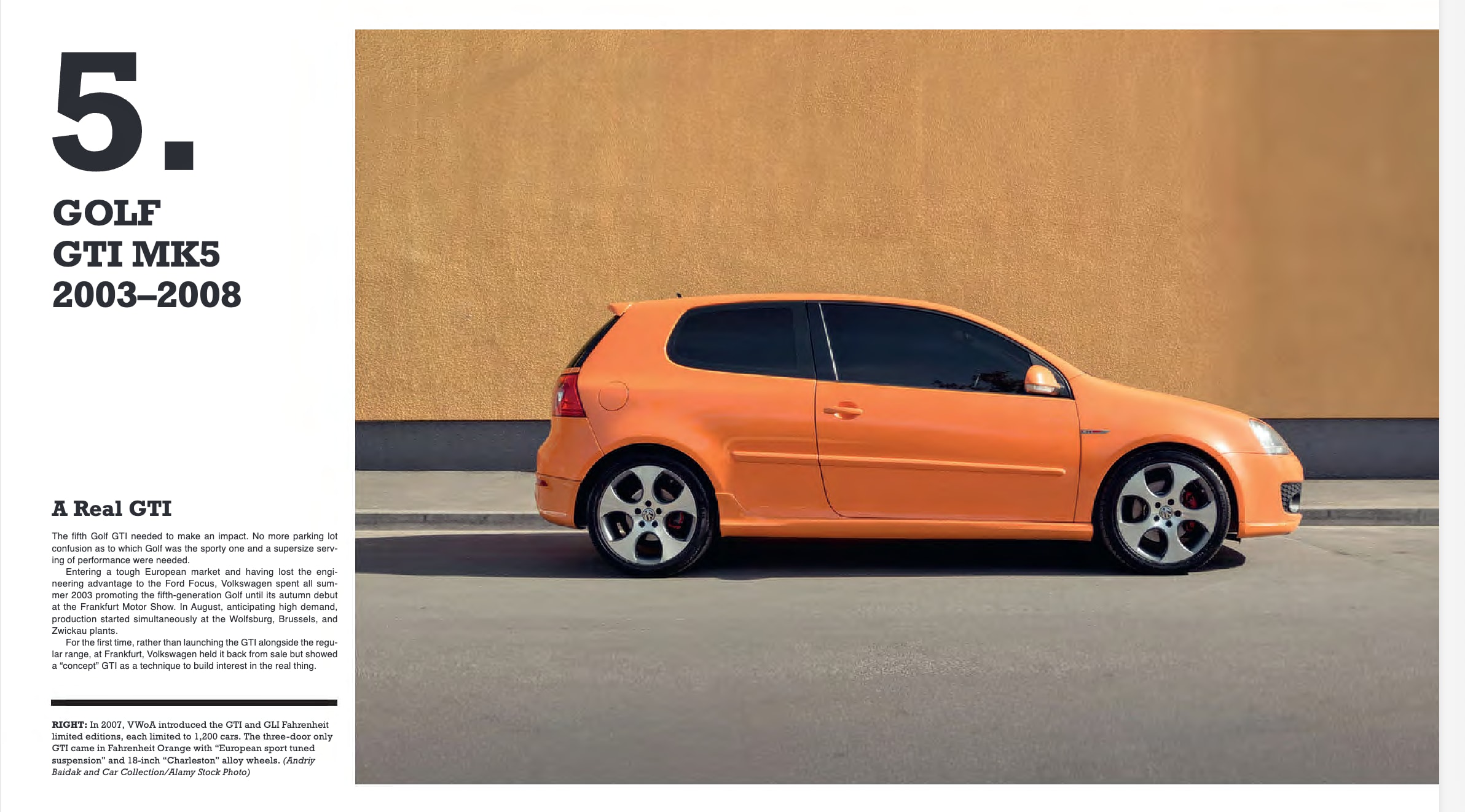
To have any credibility, a significant advancement was required for the Mk5 GTI, according to the author.
Volkswagen delivered by introducing a new, lightweight and powerful 2.0T turbocharged engine that would replace the heavy VR6. It would serve as the standard powerplant in the new GTI, which also included a new multi-link independent rear suspension, electro-mechanical steering system, and an optional dual clutch, DSG transmission and launch control from the R32.
Volkswagen also brought back the signature red stripe around the grille and tartan seats—harkening back to the original Mk1 GTI.
Visually, the Mk5 version of the GTI was easy to distinguish from the regular Golf, but particularly up front with its striking black mask surrounding the grille.
And for the first time in North America, the GTI was offered as a five-door hatchback.
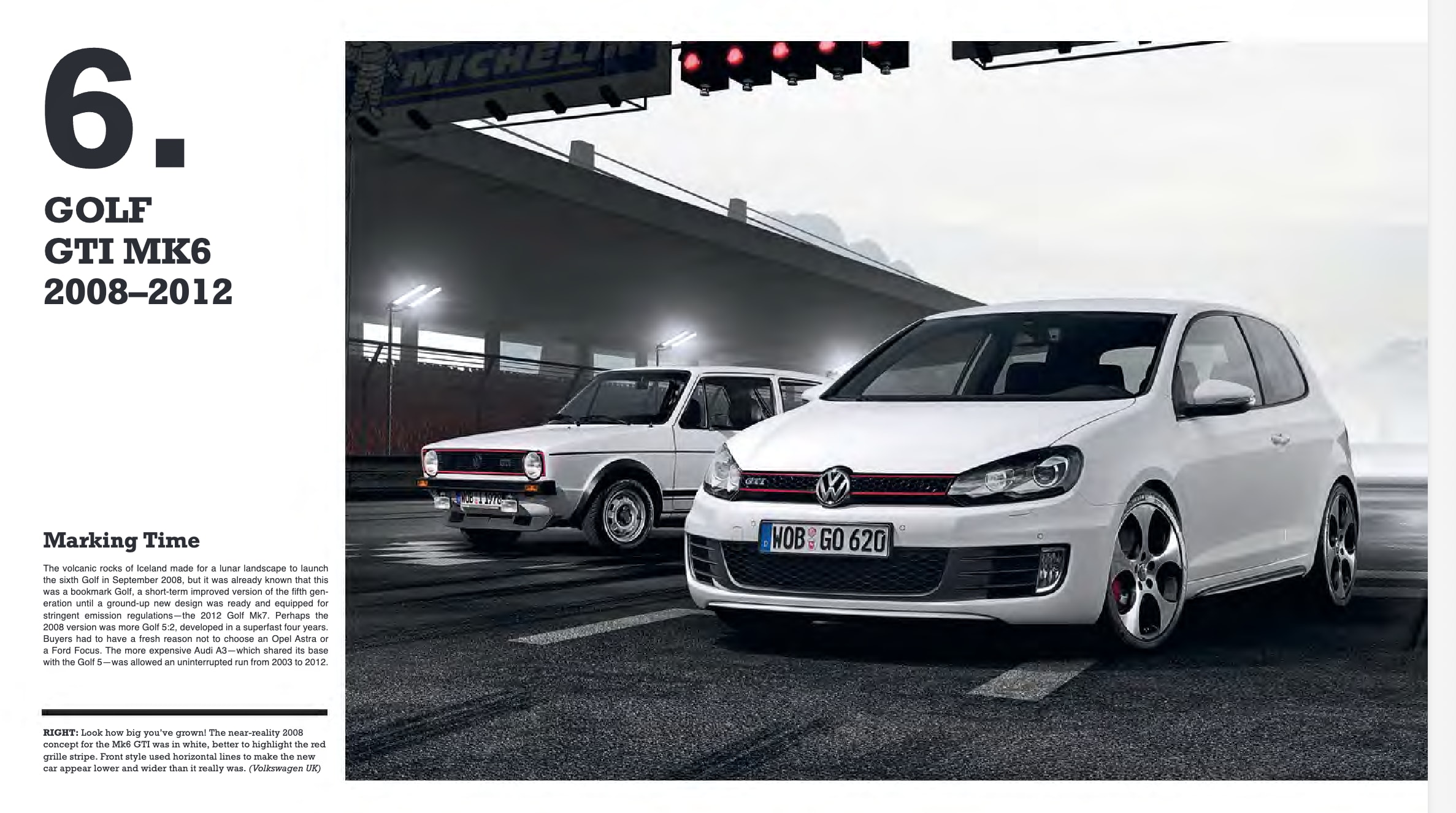
Generation Six
Author Russell Hayes describes the Mk6 as “more Golf 5.2.” Says Hayes:
“it was already known that this was a bookmark Golf, a short-term improved version of the fifth generation until a ground-up new design was ready...”
A number of cost-cutting measures were incorporated into the Mk6, according to Hayes, but not at the expense of performance. And visually, it sported new front and rear ends, along with new interior changes.
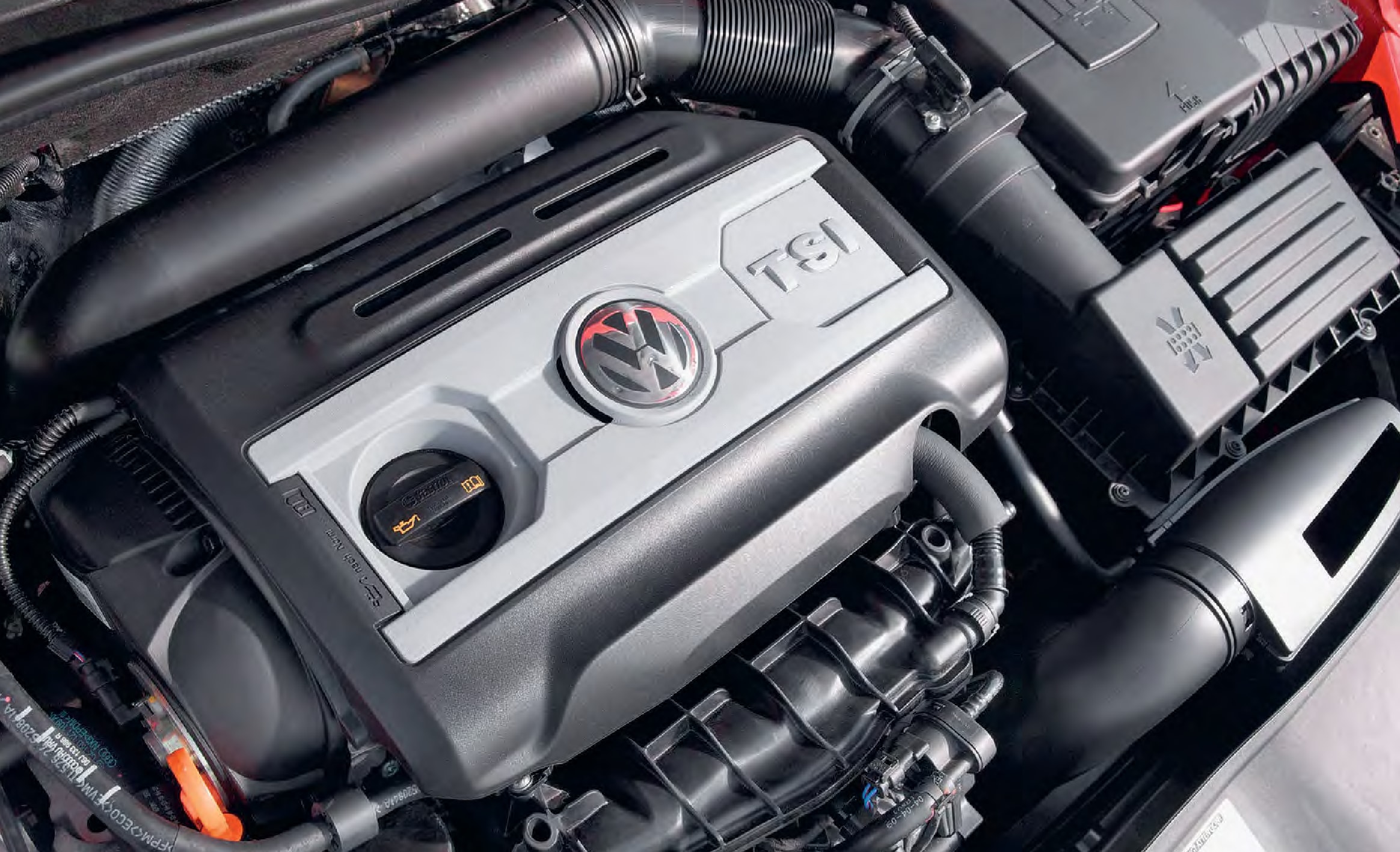
And notwithstanding the efficiency measures mentioned, the Mk6 did introduce more power to the 2.0 engine, the XDS electronic differential for better traction, and an optional three-stage Dynamic Chassis Control for improved handling precision.
Mk 7: The Sweet Spot
“So much was new in the 2012 seventh-generation Golf: new body, new plateform, new engines, and lots of new technology—and yet it was lighter. Was this peak Golf?” – Russell Hayes
As suggested by the author, the Mk7 was a high point of the GTI. It’s an opinion shared by many GTI aficionados.
The Mk7 featured Volkswagen’s new, lighter weight MQB platform, the tuner-friendly, aluminum block and more reliable Gen 3 EA888 2.0L TSI engine, an electronic front limited-slip differential, and variable ratio steering.
The Mk7 was both roomier and lighter than the Mk6, with improved handling and power delivery.
The author shares that reaction from the US motoring press was enthusiastic to the seventh generation GTI.
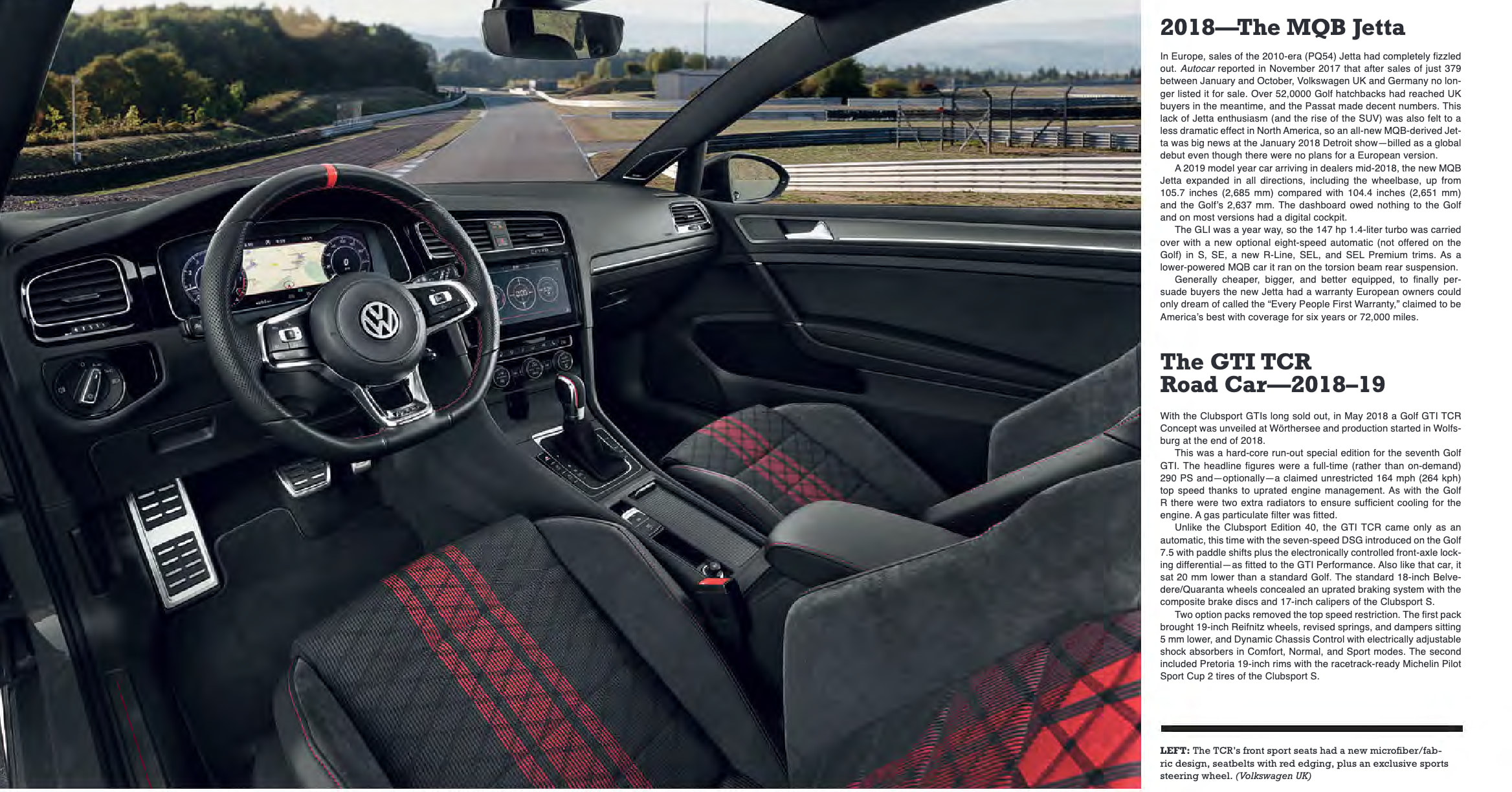
Mk7.5
If the Mk7 represents the sweet spot of GTI generations, the mid-cycle Mk7.5 was the bliss point.
Aside from a requisite facelift, the 7.5 introduced a power increase to 242-245 horsepower, a faster 7-speed DSG transmission over the previous 6-speed, larger brakes, full LED headlights and taillights, and upgraded tech in the way of standard Apple CarPlay and Android Auto, driver assistance, and the highest quality of materials yet for the interior.
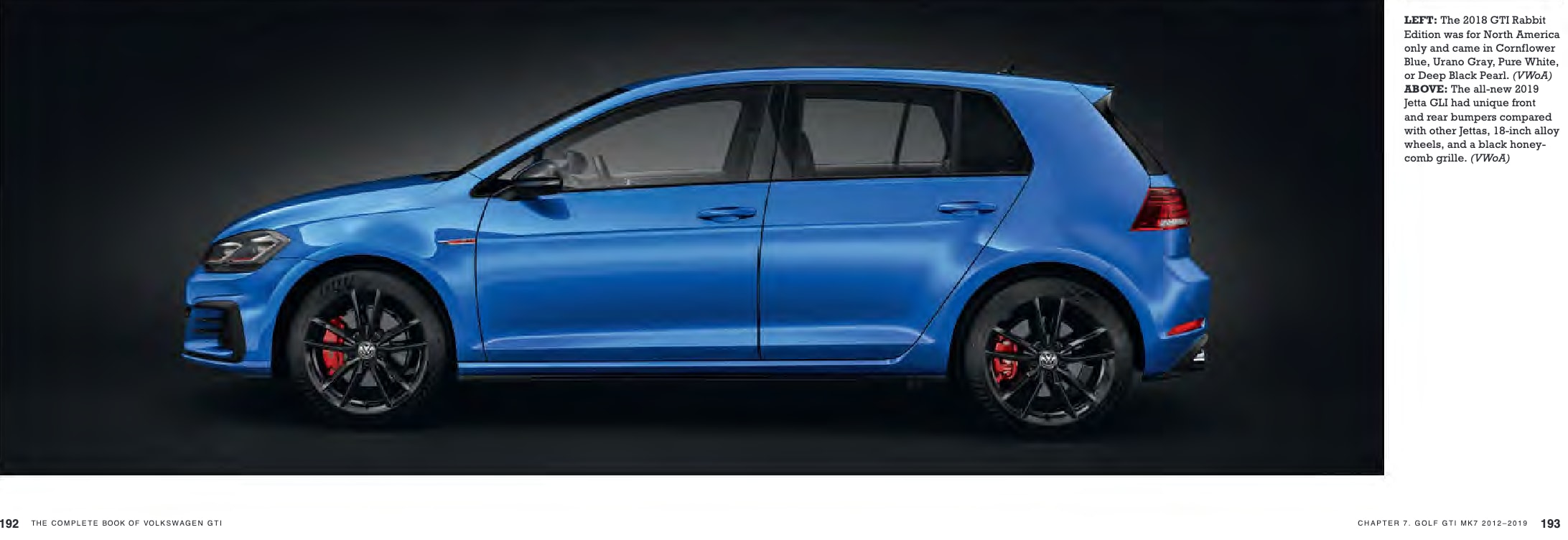
The Mk7.5 remains one of the most sought-after GTIs on the used car market.
If the Mk7 was the sweet spot, what does that make the Mk8?
With rising costs dominating the discussion in the 2020s, it may be hard to fault Volkswagen for the cost-cutting measures it took with the eighth generation GTI.
What’s noteworthy is that none of the measures appear to have negatively impacted the GTI’s performance. The Mk8 features more neutral cornering, a more engaging driving experience, increased power output (to 242-261bhp), and 0-62mph time reduced to 5.9 seconds,
What was impacted? More hard plastics on the rear door panels, a cosmetically less attractive engine compartment, haptic touch-sensitive controls on the steering wheel, and a slow-to-respond center screen replacing real buttons.
“Not a fan favorite,” said Hayes about the haptic controls and certain functions being relegated deep into the central screen (e.g., reaching the traction control required five menu commands).
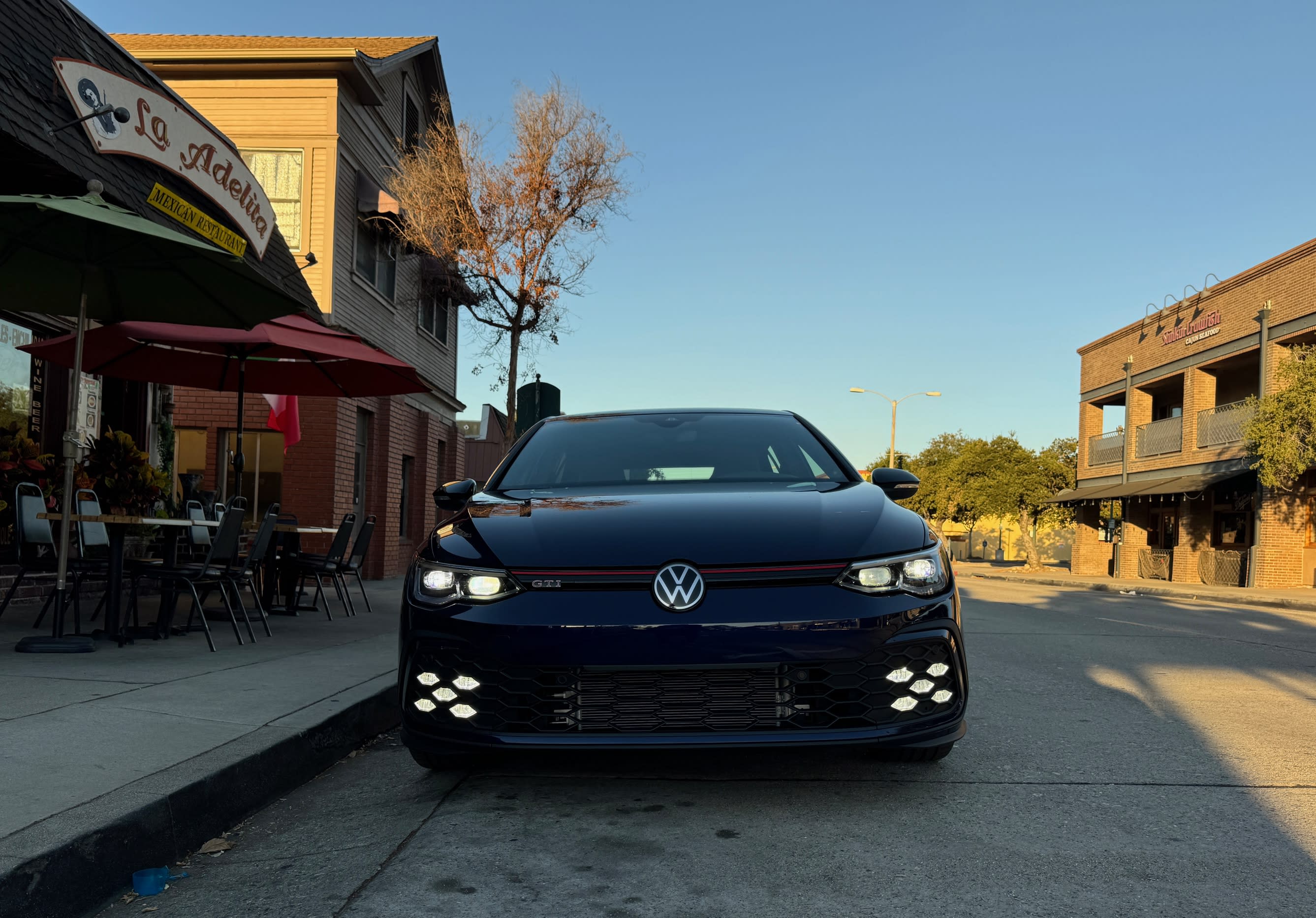
LA Car reviewed the last stick shift GTI, a 2024 Mk8 380 S. Here’s what we said:
“Detractors notwithstanding, the latest Volkswagen Golf still provides a sense of quality fit and finish above anything else in its price point. Doors still close with a solid “thunk”. Hardware has that feel of high quality. The car has the sensory perception of a model in the near luxury class rather than one that can be had for the low $30,000 range.
The GTI tradition carries over to its driving experience. As mentioned, the current GTI is the best-performing of all the generations of GTIs. Having had considerable driving experience in the Mk5, Mk6, Mk7 and Mk7.5 GTIs, the 380 S test car with the latest version of the DCC damping system handled just a bit better than them all, with more composure and fewer of the problems that can trip-up lesser front-wheel drive sporty cars.
As with its predecessors, this GTI shines for its practicality and everyday driving pleasure.” (see The Final Stick Shift GTI).
Mk8.5
The book ends with some final words about the mid-cycle update, the Mk8.5, which launched in model year 2025.
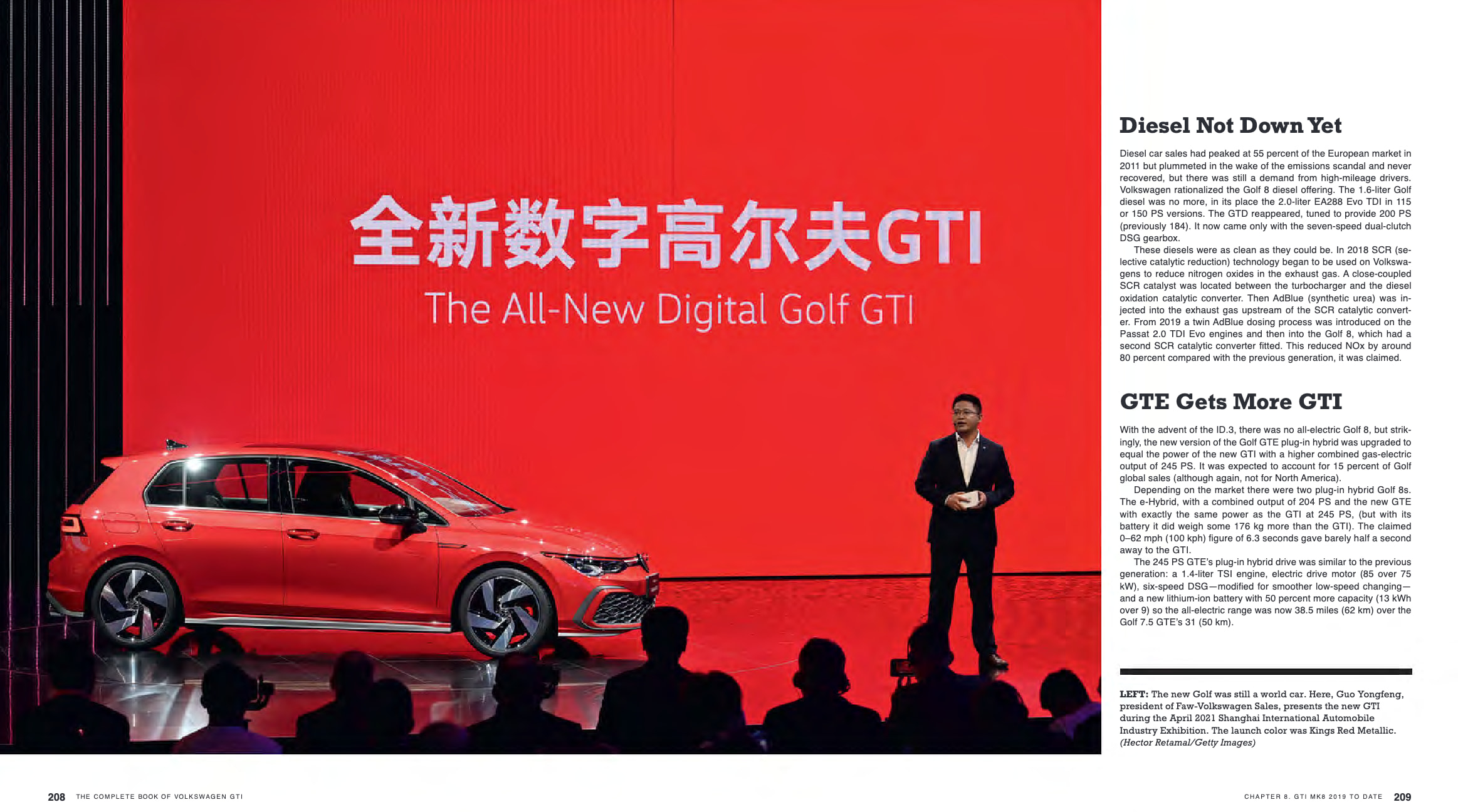
The Mk8.5 responded to criticism about the Mk8’s interior controls by going away from haptic controls and back to buttons—particularly on the steering wheel, the central screen went from 10 inches to 12.9 inches with a faster processor and more intuitive menu layout, the volume and temperature controls now backlit, and ChatGPT is now integrated into the car.
Final Thoughts
In fulfilling the quest to make The Complete Book of Volkswagen GTI really complete, Author Russell Hayes provides a global history. It’s not limited to U.S. models; models not sold in the U.S. appear frequently.
Author Hayes walks a tightrope in creating a book for the wide spectrum of GTI fans, while at the same time not sugar-coating deficiencies or weak spots throughout its 50-year range.
The Complete Book of Volkswagen GTI succeeds at doing both.
About the Author
Russell Hayes is a motoring journalist in print, television, and online whose clients have included the BBC’s original Top Gear, Channel 4’s Driven, The Times, and London Evening Standard. He’s written an eclectic mix of motoring histories on subjects as diverse as the Earls Court Motor Show, the Volkswagen Golf, and Aston Martin V8 cars. Russell is also the author of Motorbooks’ Volkswagen Beetles and Buses and The Big Book of Tiny Cars. He lives in London, England.
THE COMPLETE BOOK OF VOLKSWAGEN GTI
Every Model Since 1976
Author: Russell Hayes
Publisher: Motorbooks
Publication date: October 28, 2025
Language: English
Print length: 240 pages
ISBN-10: 0760393745
ISBN-13: 978-0760393741
Item Weight: 3.4 pounds
Dimensions: 10 x 0.85 x 12.25 inches
Available in the Los Angeles area at AutoBooks/Aerobooks in Burbank
About The Author

Roy Nakano gave birth to LACar in the late '90s. As LACar's Editor, Roy shapes the content and assigns the stories. As a writer, Roy likes to stray off the beaten automotive path: "Six Degrees of Reparations" reflected on the ethical limits taken by car companies throughout history. "Traveling Through the Past and Present of the Green Book" looked at businesses that took a stand and the man that wrote the book. "Best Cars to Drive in Rush Hour Traffic" was an LACar guide published in the pre-GPS era. "In Search of the First Datsun 510 Tuner" looked at one of the milestones in the origin of import tuners. And "Us vs Them" examines the instances when rivalry among automotive enthusiasts crossed the line to violence and even death.